(From TennesseeWorks)
What Does High-Quality Transition Assessment and Planning Mean?
During high school, students, educators, families, and other members of the educational team begin the important task of developing a transition plan outlining the student’s postsecondary goals along with the educational services, supports, and linkages that will help him or her achieve those goals. Age-appropriate transition assessments are used to help identify which transition services are most essential for a particular student. Each student’s transition plan should be unique and tailored to the individual strengths, needs, interests, skills, and strengths of the student. At the same time, each plan should create a pathway for students to move from high school to valued adult roles, including work.
As Yogi Berra said, “You’ve got to be very careful if you don’t know where you are going because you might not get there.” A relevant and well-designed transition plan is crucial to ensuring students access the instruction, experiences, and supports they need to prepare for a good job or further education after high school. The Individuals with Disabilities Education Improvement Act requires the IEPs of transition-age students to outline (1) appropriate measurable postsecondary goals based upon age appropriate transition assessments related to training, education, employment, and, where appropriate, independent living skills; and (2) the transition services (including courses of study) needed to assist the child in reaching those goals.
Why is High-Quality Transition Assessment Planning Important?
Despite the importance of involving students actively in this assessment and planning process (Carter, Brock, & Trainor, in press; Wehman, 2011), many teachers struggle to carry out transition planning in ways that fully engage youth, families, and other professionals in the process. Yet, the planning process itself is critical to transition success. For example, when young people are actively involved in writing their own transition plan, they are developing self-determination and self-advocacy skills. Unfortunately, almost one quarter of youth with an intellectual disability or autism are not even present at their own transition planning and nearly half participate minimally when they are present (Shogren & Plotner, 2012).
How Do I Write a High-Quality Transition Plan?
Although transition planning should begin by age 14 (or earlier), the transition plan is not a static document. Instead, it evolves each year to match the emerging needs and goals of the young person. Opportunities for community-based work experience are an integral piece of the transition plan. Concrete goals and steps towards achieving those goals should be clearly outlined within the plan and based upon transition assessments. Quality transition planning involves the young person in developing their own transition plan. If young people feel as though their voice is included in their transition plan, they may be more likely be committed to the identified goals and steps.
Where Can I Learn More About Transition Assessment and Planning?
The following links include guides, stories, and other resources related to effective transition planning for employment among young people with IDD:
goals.
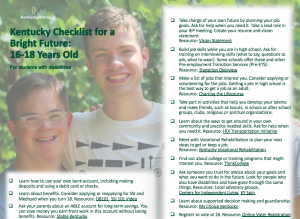
Kentucky Checklists for a Bright Future

Transition Overview Document
Transition 103: Endless Possibility – Preparing High School Students with Disabilities for Successful Transition to Employment
EMP 102: Important Predictors for Post-School Success
EMP 101: What We All Need to Know About Transition for Students with Significant Disabilities
Charting the Lifecourse Nexus
PACER’s National Parent Center on Transition and Employment
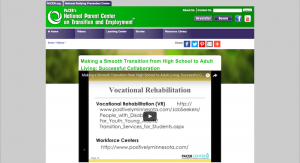
Making a Smooth Transition from High School to Adult Living: Successful Collaboration
I Want to Work Handbook
National Secondary Transition Technical Assistance Center
Kentucky Department of Education: Transition
Kentucky Post School Outcome Study (KyPSO)
Charting the Life Course: Daily Life and Employment booklet
Charting the Life Course: Transition to Adulthood booklet